

The Time Keeper's Apprentice
From The Vaults of 'Utilitarian Magic'
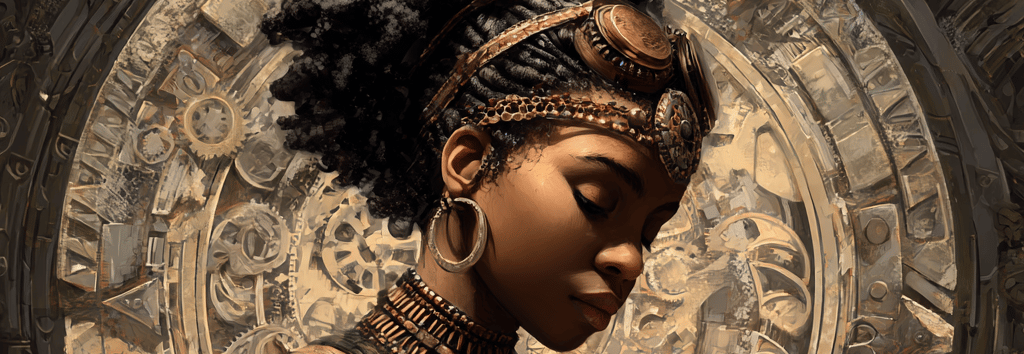
A willowy Igbo princess defies tradition to join a secret society preserving true time and rhythm.

Sacred Oath
Hidden Threat
Their sacred work sustains life, but a shadowy figure threatens their rhythm.
The Timekeeper’s Apprentice is an Afromantasy tale of love, rhythm, and the burden of knowledge. It i based on the Time Component of the Afrodeities Bridgeworks
When the daughter of an Igbo king rejects royal marriage and begs to join a secret timekeeping society, none of the elders accept her, until a lone Timekeeper, a master of Nile time and griotic rhythm, accepts her with dire warnings. Their oath is sacred: to preserve true time across the poles of the Black world, guided by the Ethiop Spirit and the Calendrical Kings. Their work prevents drought, ensures safe births, fattens crops. It is a covenant of consequence.
But the apprentice’s journey is shadowed by dread. A figure stalks the rhythm who they call him the Anti-Kmt,
She does not yet knowwhat the future holds. She only knows that her body bends to the chrono-code, that time is truth, and that duty and desire will collide.
Below is a potted version of the full tale, which is to be found in the Annals of African Myths of Utilitarian Magic.
The Time Keeper’s Apprentice
In the eastern forests where red earth held memory longer than men, there stood an Igbo kingdom whose courts were etched with uli so old the lines no longer described decoration but law. Walls bore spirals of lineage, chevrons of covenant, ochre arcs that recorded floods, harvests, eclipses, births.
This was a people who did not decorate their world. They annotated it.
The king of this land was tall and deliberate, his beard threaded with cowries marking treaties made and kept. He had sons who trained for war, sons who trained for counsel, sons whose futures were already shaped like carved stools waiting only for weight. And he had one daughter. He had trained her too, alongside her brothers, because she had the aptitude, the interest, and the excellence.
From childhood, she had a specific sort of relationship with time, and knowing.
She knew deaths before illness. She waited calmly for messengers who had not been sent. Her mother said nothing and carefully watched the shadows at dusk lengthen unevenly around the girl’s feet.
When she came of age, suitors arrived in numbers appropriate to her father’s power. Warriors with cattle. Traders with salt and cloth. Sons of titled men whose futures were orderly and profitable. She refused them all without spectacle, without bitterness, without explanation. Each refusal landed in the court like a dropped calabash, intact but loud.
At last, summoned before her father beneath the great uli wall of Ancestral Reckonings, she spoke.
“I will not marry,” she said. “Not now. Not as exchange. Not as destiny given to me by the calendar of others.”
The court stirred. Her father raised his hand.
“What then do you ask?”
She did not lower her gaze.
“I ask to use my learning as the boys do, and beyond that, to learn what the boys learn that is never written. I ask to be counted among those who keep the measures. I ask to enter the society that records when a thing must happen, not merely that it has happened.”
Silence followed. Then laughter, careful and edged.
That society had a name, though it was never spoken aloud. They were the Time Keepers — a very few, mostly men, trained not only in ritual but in reckoning. They tracked moon and shadow, tide and decay, the swelling of yams, the migration of birds, the intervals between drought and renewal. Their tools were not charms but calibrated staffs, knotted cords, water clocks hidden in clay, drums tuned to durations rather than pitches. They understood that time was not a river but a field, planted and harvested according to laws older than kings.
Women were not admitted. Not because they were thought incapable, but because the order had been structured wrongly long ago and had mistaken tradition for necessity. Initiates were rarely accepted at all. They were chosen.
The elders refused her. Calmly. Absolutely. They would not put her forward.
One night, as the court lamps dimmed, a man stepped forward from the shadowed edge of the hall where griots sat when they were not speaking.
He was not young. His hair was braided with copper wire etched with marks too fine to be decoration. His staff was segmented, each join precise. When he moved, the air seemed to arrive before him, as though anticipating his weight.
“I will take her,” he said.
The court stiffened.
He was known. All were known, but some were known differently. He was a Time Keeper who had also been a griot, trained to speak memory aloud as well as to measure it silently. He had wandered farther than most, crossing forest and savannah, river and ruin, adjusting calendars where they had drifted, correcting festivals that had slipped out of alignment with their purpose. He had been a soldier and an architect. Some said he could tell when a child conceived would become a king or a catastrophe. Others said he was dangerous because he did not flatter fate.
The king studied him.
“If you take her,” the king said, “will she ever return? She is the only daughter of her mother, and her heart will grieve the essence of this girl.”
The griot’s response was instantaneous.
“She may not return.”
A murmur rose. The girl did not move.
He turned to her.
“There will be hazards. Roads with no way back. Friendships you will leave behind. There may or may not be love. There will certainly be work. There will be study. There will be treachery and danger. And you will very likely not return.”
The girl inclined her head.
“I ask for nothing more. If I return, I return. If I do not, I serve Time. That is enough.”
“What do you offer in exchange?” the king asked.
The man’s eyes met the girl’s for the first time. Something passed between them; not desire, but recognition, like two clocks striking the same hour in distant towns.
“I offer truth,” he said. “And I offer her the discipline to survive it.”
The king turned to his daughter.
“If you go,” he said, “you will not belong to this court again. Not fully. You will carry knowledge that makes home unfamiliar.”
She bowed.
“I already do.”
The uli on the walls seemed to darken, as if absorbing the moment. Her father rose, removed the coral from his own wrist, and placed it on hers. Not as marriage. As sanction.
“Go,” he said.
At dawn she left her father’s court, its uli walls watching as if memorising her shape. She swore the Oath of Rhythm — to keep time pure through soil, sound, ceremony, and restraint.
Together they travelled, aiding Calendrical Kings, tending rivers, ensuring rains arrived neither early nor late. Crops held. Children survived. Time behaved.
They travelled beyond named roads. She learned to listen to soil for exhaustion, to water for impatience, to wind for warning. She learned that African time was not counted but kept, maintained like a fire that must neither flare nor die. She learned the difference between ritual and mechanism, between superstition and applied metaphysics. She learned that magic was simply the name given to science whose proofs had been stolen.
At night, he taught her to speak memory aloud so it would not calcify. By day, he taught her to measure shadows not by length but by intention. Slowly, the world began to behave again around her.
When love came, it did not announce itself. It emerged as inevitability, the way eclipses do when all the bodies have been moving correctly for long enough. It was not forbidden, because nothing in their order forbade what had never been anticipated. It was not gentle, because time rarely is. It was precise, aligned, earned.
It was during a storm — one summoned to correct a drifted season — that she first sensed the disturbance.
An uneven... beat.
A thunder that arrived on schedule rather than necessity.
Later, in a market whose dance no longer matched its breath, she heard his name spoken carefully.
The Anti-Kemet.
He did not destroy time. He refined it. He extracted rhythm from land and returned it as schedule. Where the Time Keeper listened, the Anti-Kemet imposed. Where calendars bent to soil, he made soil obey clocks. Rivers were archived. Festivals standardised. Kings were offered efficiency in exchange for forgetting.
The Time Keeper did not speak of him, which frightened her more than denial would have.
As they travelled on, she noticed small fractures. A harvest that required correction. A staff that hummed incorrectly. A moment — fleeting but real — where her master hesitated. Not in fear. In curiosity.
She began to understand that the danger ahead was not annihilation.
It was conversion.
The Anti-Kemet did not seek to kill Time Keepers.
He sought to recruit them.
And the apprentice, listening always between beats, began to realise that the oath she had sworn might one day require her to choose — not between men, but between rhythm and the promise of control.
Some stories are about origins.
This one is about what happens when time is no longer allowed to belong to the land.
The rest of the tale is kept elsewhere.
As time itself prefers.
A journey through rhythm, love, and ancient secrets in the black world.