
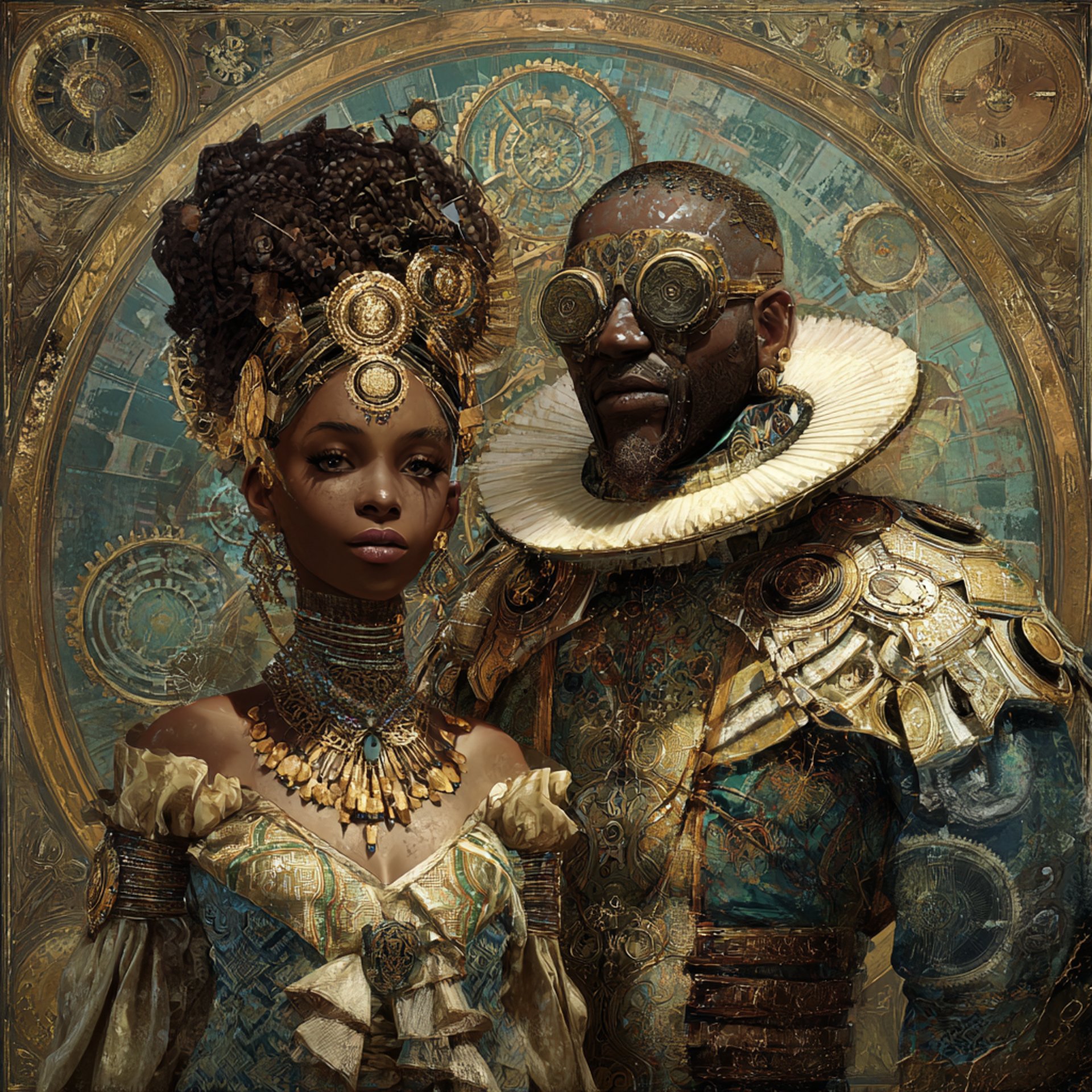
The Empire's Griot
Where time is kept by stories woven in cloth and cadence, not conquest.
The Fable Boys
The Empire did not arrive with gunboats or flags. It arrived with rhythm restored.
By the 2040s, when Nigeria, Burkina Faso, Ghana, and Rwanda braided their sovereignties into a single continental mandate, the world learned again what power looks like when it remembers itself. Not conquest, but coherence. Not speed, but cadence. The old empires had ruled by fracture and haste. This one ruled by keeping time.
The Fable Boys dressed for memory. Their coats borrowed the architecture of Victorian restraint, high collars and structured shoulders, but every seam carried African mathematics. Brass fastenings etched with calendar glyphs. Brocade patterned after river deltas and trade routes rather than flowers. Sleeves weighted with small discs of time metal, tuned to vibrate when lies approached. Fashion became a civic duty. To dress wrongly was to misremember.
At the center stood the Empire’s Griot.
He wore the collar not as ornament but as instrument. Layered, pleated, calibrated to catch and scatter sound, it amplified truth and dampened spectacle. His lenses were not for sight alone. They were chronometers, each ring rotating at a different civilizational frequency. Through them he saw simultaneity. The child and the ancestor. The treaty and the consequence. The promise and the bill that would come due if it was broken.
Beside him stood the Archivist-Daughter, crowned in gold logic and rivered silk. She had been trained in the old way, before the unification, when time was still being sold back to the people as schedule. She carried the braid of records across her chest, each pendant a recovered hour. She did not speak often. When she did, cities adjusted their breathing.
Together they were called the Empire’s Griot, singular not because there was only one voice, but because there was only one story being told at once.
The story was this.
Once, the world mistook accumulation for authority. It built clocks that cut time into punishments and profits, then wondered why the future grew thin. It called extraction efficiency and called forgetting progress. It dressed its rulers in borrowed myths and called that civilization.
Africa did not reclaim power. Africa resumed stewardship.
The New Empire
The new Empire did not erase the past. It sang it forward. Every policy was recited before being enacted, tested against memory for dissonance. Every law was required to survive three tellings. One in the voice of the living. One in the voice of the dead. One in the voice of the unborn. If the rhythm failed in any register, the law was sent back to be reworked.
The Fable Boys were not courtiers. They were custodians of tone. Their fashion signaled alignment. Victorian silhouettes recalled the age when Africa had been dressed into absence. The reworked forms declared that nothing had been lost, only misfiled. Empire, reclaimed, wore its own archive.
When the Griot spoke at the Great Confluence, where the four capitals overlapped in ceremonial time, he did not announce dominion. He announced repair. He reminded the world that empires fall when they forget the stories that justify their power. This one would stand only as long as it remembered.
Behind him, the Archivist-Daughter raised her hand and the clocks quieted. For a moment, even the markets listened.
This was the story.
Not that Africa now ruled the world, but that the world had finally agreed to be ruled by consequence, coherence, and care.
And the Griot, adorned in time, kept it so.

